The Complete Export Process from A to Z: Latest Update 2026
Masterexport process The 2026 standard not only helps businesses optimize costs but also serves as a solid shield against legal risks.This article will provide a detailed roadmap, from customs procedures to practical experience, serving as a guide to help you confidently master the supply chain and sustainably bring Vietnamese products to the international market.
1. What is goods export?
Exporting goodsThis refers to the sale of goods and services to foreign partners, where goods are moved across national borders or from specific areas (such as export processing zones).
In 2026, exports will no longer be simply containers on ships. With the introduction of...Regulations on customs management for goods exported and imported through e-commerce transactions.This process has been streamlined, allowing smaller packages to pass through faster via a centralized electronic data system.

2. Common export methods today
Before you begin, you need to determine the appropriate model:
-
Direct export:Businesses find customers, sign contracts, and handle paperwork themselves. Profits are high, but it requires strong professional skills.
-
Indirect export (Consignment):It's safer for beginners to use an import/export service agency as a proxy, but it incurs commission fees.
-
Export processing:Manufacturing based on partner orders (common in the textile and footwear industries).
-
On-site export:Delivering goods to foreign partners directly within Vietnam.
-
Exporting through e-commerce(CBEC):Selling through Amazon, Alibaba, etc. This is a form of business that the government is prioritizing and supporting, with separate customs clearance procedures.
3. Detailed nine-step process for exporting goods.
For a shipment to successfully "cross the border," businesses need to strictly adhere to the following steps:
Step 1: Market research and customer identification
Focus on the actual needs of the market by leveraging data from the Ministry of Industry and Trade or industry reports. Having a presence on B2B platforms like Amazon, LinkedIn, or at international trade fairs will help you quickly connect with potential importers.
Step 2: Negotiating and signing foreign trade contracts
A contract is the legal framework that protects the rights of both parties. You need to pay special attention to Incoterms conditions and choose a secure payment method. L/C To ensure a stable cash flow for the business.
Step 3: Apply for an export license.
For specialized items such as chemicals or agricultural products, obtaining permits from relevant ministries and agencies is mandatory. Please ensure you comply with the latest regulations, such as: Decree 113/2017/ND-CP to ensure a smooth customs clearance process.
Step 4: Prepare goods and conduct quality checks.
Goods need to be packaged according to shipping standards and clearly labeled (Shipping Mark). Collaborating with reputable inspection agencies to obtain quality certifications will help Vietnamese products easily gain the trust of foreign partners.
Step 5: Purchase cargo insurance
International shipping always carries inherent risks. A suitable insurance policy is a necessary investment that helps businesses protect their finances and provides greater peace of mind against damage or loss during transit.
Step 6: Booking transportation
Based on Incoterms conditions, you proceed to book a train or plane. If selling at a price... CIF Businesses proactively work with Forwarder if sold at price FOB You just need to coordinate with the transport agent designated by the customer.
Step 7: Complete export customs procedures.
This is a crucial step for officially exporting goods. Businesses declare their goods on the ECUS/VNACCS system. For e-commerce goods, providing electronic data early will significantly shorten customs clearance time.
Step 8: Hand over the goods to the shipping company.
After customs clearance is granted, you proceed with handing over the container at the port or storing it in the airport warehouse. Ensuring timely completion at this stage helps the goods be loaded onto the transport vehicle according to the scheduled timetable.
Step 9: Complete the paperwork and receive payment.
Finally, you send the documents (Bill of Lading, Invoice, Certificate of Origin, etc.) to the customer to receive payment. Don't forget to provide the Certificate of Origin (C/O) to help your partner benefit from preferential tariffs in their country.
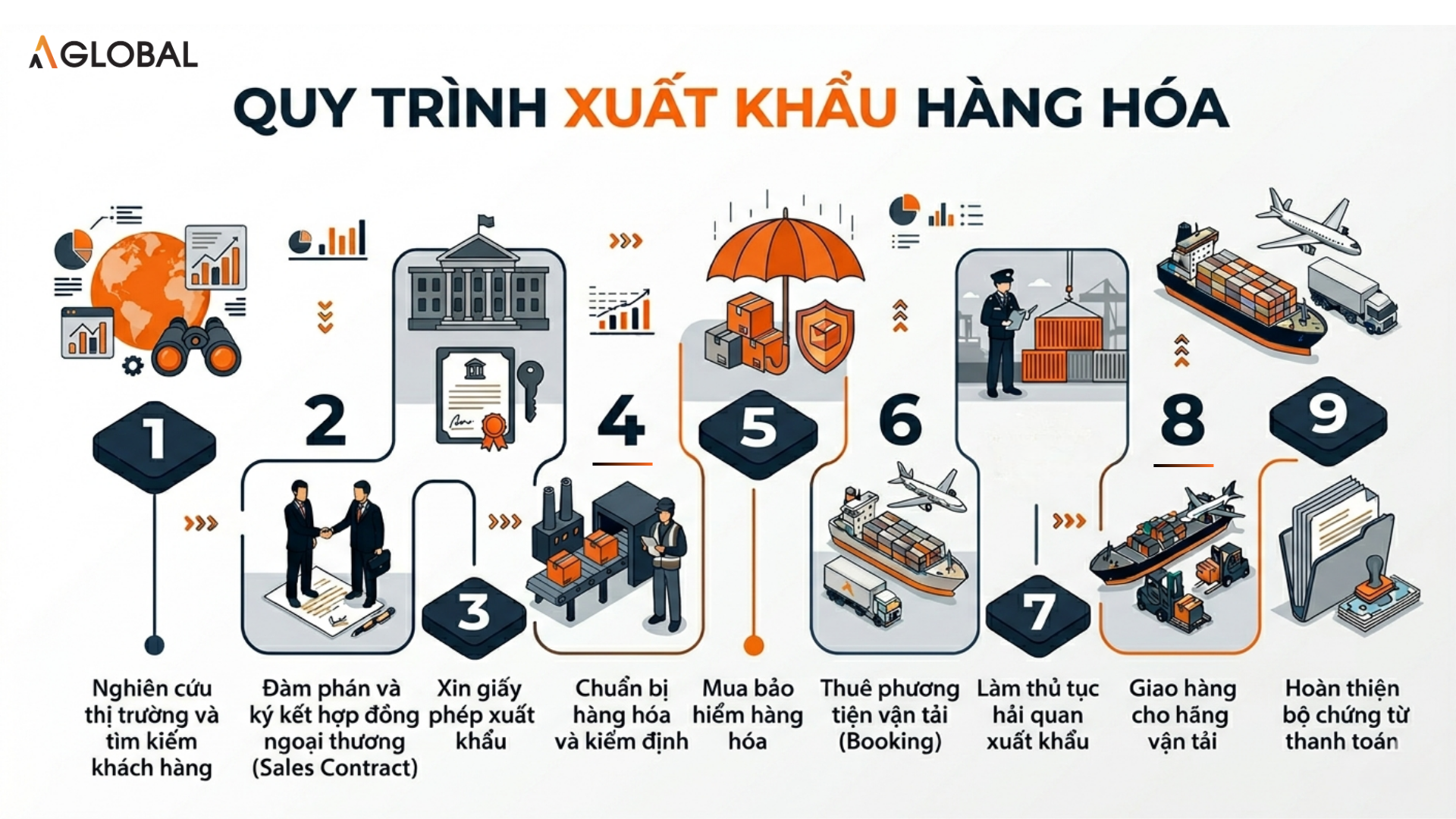
Steps in the goods export process
Read more:What are Incoterms? Understanding Incoterms
4. New development: Exporting via e-commerce
Based on the new regulations on managing cross-border e-commerce goods, the export process has undergone significant changes:
- Separate information system:Businesses provide order information before goods arrive at the border, helping to shorten customs clearance time to just a few hours instead of several days.
- Discounts on low-value goods:Small orders below a certain threshold may be exempt from export tax and have simplified documentation.
- The role of e-commerce platforms:When selling on Amazon Businesses can leverage integrated logistics services (such as: FBA - Fulfillment by Amazon) to synchronize the process from order confirmation to final delivery.
5. What does a complete set of import/export documents include?
To ensure a smooth export process, you need to prepare a complete set of documents:
|
Type of document |
English name |
Purpose |
|
Foreign trade contract |
Sales Contract |
A legal agreement between the two parties. |
|
Commercial invoice |
Commercial Invoice |
Payment documents and customs declarations. |
|
Packing slip |
Packing List |
Details of product specifications and weight. |
|
Bill of Lading |
Bill of Lading (B/L) |
Proof of ownership of goods, issued by the shipping company. |
|
Certificate of Origin |
Certificate of Origin (C/O) |
Help customers benefit from tax incentives. |
|
Quarantine/Inspection Certificate |
Phytosanitary/Quality Cert |
Confirm that the goods are clean, safe, and meet the required standards. |
|
Customs declaration |
Customs Declaration Form |
Declare product data |
6. Types of costs in the export process
Accurate cost management in the export process helps businesses secure their target net profit:
-
Warehouse charges:Packaging, labeling, and warehousing.
-
Domestic shipping fee:Trucks/containers moving from the warehouse to the port.
-
Port fees (Local Charges): THC, Seal, THC, Bill fee...
-
International shipping rates (Ocean/Air Freight).
-
Customs service fees(if outsourced).
-
Export tax(If applicable - most goods in Vietnam are encouraged for export with a 0% tariff rate).
7. Hard-earned lessons for beginners
Understanding the following points will help you run your export process smoothly and minimize potential risks:
- Check the HS Code carefully:Incorrect HS codes can lead to incorrect tax application, potentially resulting in heavy penalties or shipment delays.
- Don't overlook the Shipping Mark:Lack of information on the cargo containers will make the search and inspection process at the destination port a "disaster".
- Verify the credibility of your partners:For e-commerce orders, check the buyer's rating on the platform. For large contracts, require a minimum 30% deposit.
- Leverage technology:Use logistics management software to track order progress in real time.
Read more:The process of exporting goods and important points to note.
8. Conclusion of the goods export process
The process of exporting goods in 2026 is becoming simpler and more efficient thanks to cross-border e-commerce. To optimize operations, logistics, and develop international sales... Amazon Businesses need an experienced partner to work with them.
AGlobal – a trusted partner chosen by Amazon Vietnam.– will support businesses in building and expanding their global export operations in a systematic and sustainable manner.
Register for a free one-on-one consultation tailored to your business's specific industry sector today!Here!