E-commerce marketplace outsourcing for businesses in 2026
In 2026, operating an e-commerce marketplace is no longer a “do-it-all-in-house” game, but a race of speed and efficiency. As a result, outsourcing e-commerce marketplace operations has become a strategic choice for many businesses.
1. What is e-commerce marketplace outsourcing?
It is important to understand the basic concept and the key operational areas that businesses can outsource in the process of running an e-commerce marketplace.
1.1. Definition of e-commerce marketplace outsourcing
E-commerce marketplace outsourcing is a model in which a business delegates all or part of its online business operations to an external professional service provider. The outsourcing partner handles operations ranging from sales growth to content optimization and advertising management, allowing the business to operate without building an in-house team.
Businesses do not need to recruit or manage internal staff and can instead leverage an outsourced team with established processes, expertise, and tools.
1.2. What functions can be outsourced?
What tasks can businesses outsource?
Businesses can outsource specific parts of their e-commerce marketplace operations depending on their needs and internal resources. Common outsourced functions include:
-
Product listing creation and optimization: titles, descriptions, images, SEO-optimized content aligned with Amazon algorithms
-
Paid advertising management and optimization: Sponsored Products, Sponsored Brands, Sponsored Display
-
Inventory management and FBA operations: stock monitoring, timely restocking, handling excess inventory
-
Customer service: responding to reviews, handling complaints, protecting account health
-
Periodic performance reporting: revenue, conversion rate, advertising cost of sales (ACoS)
-
Market research and consultation for expanding new product categories
Depending on the service provider, businesses can choose to outsource the entire operation or specific functions based on actual needs.
2. Why is e-commerce marketplace outsourcing becoming a trend in 2026?
E-commerce marketplace outsourcing has become a 2026 trend due to major changes in costs, competition, and business operations.

2.1. Rising internal staffing costs
Building an in-house e-commerce operations team requires significant costs across multiple roles such as account managers, advertising specialists, content staff, and designers. In addition to salaries, businesses also need to invest in training, supporting tools, and ongoing operational management.
Meanwhile, marketplace management service packages help businesses optimize budgets by leveraging experienced teams with established workflows. As a result, outsourcing is increasingly chosen as a more flexible and efficient cost solution.
2.2. Increasingly intense marketplace competition
As of December 2025, Amazon has attracted more than 9.7 million sellers worldwide. Vietnamese sellers are directly competing with competitors from China, India, and Southeast Asia who already operate with highly professional processes.
A poorly optimized product listing or inefficient advertising can quickly reduce product visibility on Amazon. Therefore, professional marketplace management is no longer a competitive advantage - it has become a requirement for survival.
2.3. AI and automation are transforming operations
E-commerce operations are inherently complex, involving product management, advertising, inventory control, and customer service. As AI becomes more deeply integrated, operational complexity increases even further.
Beyond investing in technology, businesses also need skilled teams capable of operating and optimizing AI tools effectively. This is another key reason why demand for professional outsourcing services is growing.
2.4. Focusing on core business priorities
Businesses no longer need to allocate resources to building and managing internal operations teams. This allows them to focus more on product development, market expansion, and brand building. Outsourcing partners also handle market research and data analysis, helping businesses develop more effective strategies.
Outsourcing enables businesses to focus on core value drivers such as improving product quality, sourcing suppliers, and building long-term growth strategies. This is a key factor in improving long-term e-commerce marketplace performance.
3. Which businesses should outsource marketplace operations?
 Outsourcing is suitable for two main groups: businesses/brands and small sellers or teams. Each group has different needs.
Businesses/brands:
-
Manufacturers looking to expand into international markets but lacking operational expertise
-
Fast-growing brands that do not yet have sufficient resources to build an internal team
-
Businesses aiming to optimize operational efficiency to focus on strategy and product development
Small sellers or teams:
-
New sellers who need to shorten the learning curve and avoid early mistakes
-
Small teams looking to scale without increasing staffing costs
-
Sellers facing issues with account health, advertising, or performance
-
Sellers who want to standardize operations for more sustainable growth
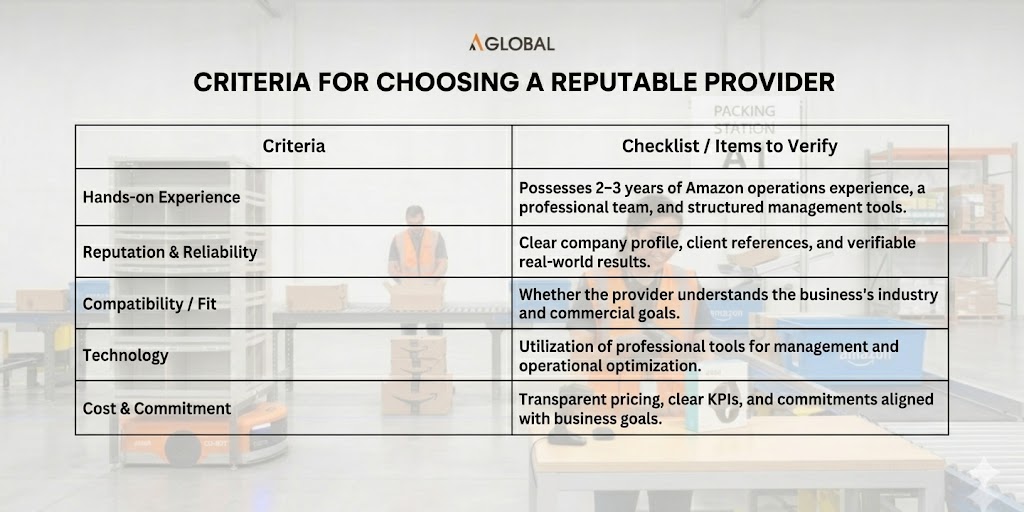
4. Criteria for choosing a reliable e-commerce marketplace operations provider
Choosing the wrong e-commerce marketplace management provider can cause significant damage to a business’s selling account. Below are essential criteria that cannot be overlooked when evaluating an outsourcing provider:
Partner with us to grow your Amazon business effectively.
Connect here to receive your free 1-on-1 consultation with AGlobal’s top experts.