How to Use AI Applications in E-commerce
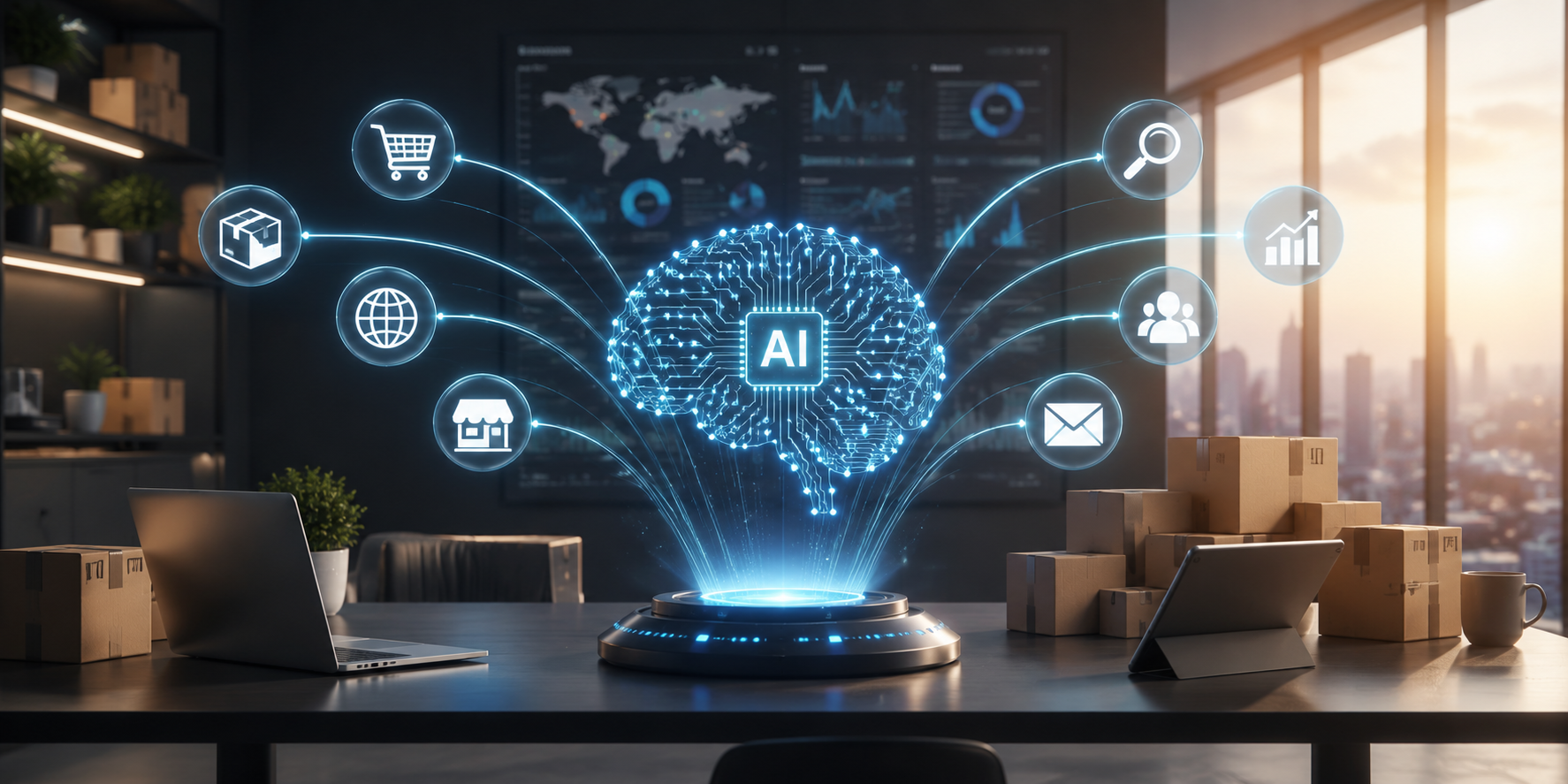
The development of AI is changing the way businesses operate across multiple channels. From cost optimization and process automation to personalizing customer experiences, AI applications are becoming a competitive advantage that businesses need to seize for sustainable growth.
1. The application of AI in e-commerce is gradually becoming a "mandatory" task for businesses.
Multichannel e-commerce in 2026 is witnessing a dramatic technological shift. Manual operations are gradually revealing their limitations in the face of enormous workloads. Below is how the market landscape is changing and the new pressures from the system.
1.1. From competing for resources to mastering multi-channel technology.
Previously, the e-commerce race was a place where businesses competed based on financial resources and practical experience. But the landscape has changed. With Amazon, Walmart, and TikTok Shop all integrating artificial intelligence into their systems, the game has shifted to mastering technology.
At this point, AI applications are no longer a "secret weapon," but have become a necessary condition for businesses to survive. If you don't soon apply AI to automate operations, the enormous workload of multi-channel operations will quickly overwhelm all your manual efforts.
1.2. Pressure from the floor algorithm and the big data processing problem
The biggest challenge lies in managing multiple different ecosystems. Amazon FBA and Walmart WFS require tight control over inventory, supply chains, and listing quality. Meanwhile, TikTok Shop demands that businesses continuously produce new content to reach customers.
Furthermore, search algorithms like Amazon A9, Walmart Search, and TikTok Shop Shopping Tab are constantly evolving. These systems prioritize content that directly addresses user needs rather than simply optimizing keywords.
This makes operations based on intuition inefficient. Businesses need systems capable of processing large amounts of data, making quick decisions, and continuously optimizing performance. That's the role AI is playing.
Read more:What is Amazon? Exploring Amazon's Business Potential
2. Core AI applications are reshaping Seller's operational machinery.
AI is not just supporting a single process but is participating in the entire operational lifecycle of e-commerce businesses. From market research and listing creation to advertising and inventory management, every link can be upgraded with data and automation.
2.1. Understanding algorithms and optimizing listings for SEO
One of the most effective applications of AI is optimizing product display pages. Instead of spending weeks on manual research, businesses can use Generative AI.
This is a technology capable of automatically generating new content such as text, images, or videos. It operates based on input requests (prompts) from the user.
This tool automatically analyzes thousands of customer reviews, allowing businesses to optimize their sales content across multiple channels.
To boost sales, current AI applications focus on three core areas. First, AI analysis and evaluation to identify competitor weaknesses. For example, on TikTok Shop, if the AI detects a customer complaining about a competitor's thin fabric, you should immediately include the keyword "thick fabric" in the title.
Next, AI content creation helps write product descriptions that are natively accurate. Examples include tools like ChatGPT or Google Gemini. When listing products on Walmart US, AI automatically selects language that suits the tastes of local users instead of a rough translation.
Finally, AI processes images and videos to optimize visuals. With just a photo of a water bottle, AI can seamlessly integrate it into a gym setting.AmazonThis collaboration helps increase conversion rates and reduce external staffing costs by 80%.
2.2. Automating large-scale digital content and short video production.
One of the most common problems today is the depletion of content ideas. When operating multiple products and platforms simultaneously, businesses find it difficult to maintain a consistent content production pace using traditional resources.
AI is completely changing this problem. From just a product URL or a few short lines of description, the system can automatically generate advertising scripts, video content, and visual media.
Platforms like CapCut Web AI, Pebblely, and Photoroom Enterprise allow for the mass creation of lifestyle images, promotional videos, and social media content without the need for a large studio or production team.
This helps businesses maintain a continuous presence on TikTok Shop while meeting the demand for high-quality images from Amazon and Walmart at a significantly lower cost.

Read more:TikTok Shop - A-Z Guide for Beginners.
2.3. Optimizing advertising costs and smart bidding.
Advertising costs are one of the biggest budgets for e-commerce businesses. However, tracking thousands of keywords and adjusting bids in real time is almost impossible to do manually.
AI PPC platforms like Perpetua, Quartile, and Pacvue are capable of managing campaigns 24/7. The system continuously evaluates the effectiveness of each keyword, automatically adjusts budgets, and allocates resources to ad groups with the highest conversion potential.
AI also helps eliminate keywords that consume budget but don't generate revenue. This contributes to sustainably improving ACoS, TACoS, and ROI metrics.
Instead of focusing on manual operations, the marketing team can dedicate more time to growth strategies and market expansion.
2.4. Automating pricing to win the Buy Box
On Amazon and Walmart, price is one of the factors that directly affects the chances of winning a Buy Box. However, tracking hundreds of competitors and constantly updating prices is a very complex task.
Dynamic pricing systems like SellerSnap or RepricerExpress use AI to monitor market fluctuations in real time. The system can adjust prices within the profit margins set by the business.
As a result, the product maintains its competitiveness without affecting profit margins. This is especially important for highly competitive industries.
2.5. Supply chain forecasting and intelligent supply chain management.
Out-of-stock or over-inventory situations are mistakes that can significantly reduce profits. AI helps businesses solve this problem by analyzing sales data, seasonal trends, and production timelines.
Platforms like Prediko and SoStocked are capable of forecasting future demand based on historical data and current market signals.
As a result, businesses can create more accurate procurement plans, optimize cash flow, and reduce the risk of incurring overdue warehousing costs.

3. Barriers and risks for businesses when implementing AI systems.
Despite its many benefits, AI is not a magic bullet that can solve all problems overnight.
The "Garbage In, Garbage Out" principle remains true. If the input data is inaccurate, AI will produce erroneous results. Product information, inventory reports, and sales data need to be standardized before being fed into the system.
Another risk is the misuse of AI-generated content. If businesses publish a large amount of unmoderated content, the listing could be flagged as spam or fail to meet the platform's quality standards.
Data security is also a concern. Information related to revenue, customers, and business strategy should not be directly uploaded to public AI platforms without appropriate control mechanisms.
AI can improve human performance, but it cannot completely replace the roles of management, oversight, and strategic decision-making within a business.
4. A 3-step roadmap for applying AI to multi-channel e-commerce systems for businesses.
For maximum effectiveness, businesses should implement AI in stages rather than investing all at once.
Step 1: Optimize the front-end
Prioritize the application of AI to images, videos, and SEO listings. This group of activities has the potential to create a quick impact on click-through rates and conversion rates.
Step 2: Optimize operations and marketing (Back-end)
After improving sales performance, businesses can expand into automated PPC advertising, customer service chatbots, and marketing data analytics tools.
Step 3: Supply Chain Optimization (Sustenance)
The final stage involves integrating AI into inventory management, demand forecasting, and cash flow control. This step helps businesses maintain sustainable long-term growth.
5. Conclusion
AI is fundamentally changing how e-commerce operates and competes. Businesses that leverage data and automation will gain a significant advantage in terms of both cost and speed.
To optimize, management should consider AI as part of an overall digital transformation strategy. Start with core processes such as optimizing product content, running ads, and managing inventory.
On platforms like Amazon, Walmart, and TikTok Shop, AI is no longer something to experiment with. This technology has become a mandatory foundation for businesses to achieve sustainable long-term growth.
Register for a free one-on-one consultation tailored to your business's specific industry sector today!Here!