How Are E-Commerce Businesses Using Ai To Better Understand Customers, Optimize Operations, And Drive Revenue Growth?
Artificial intelligence (AI) is reshaping the way businesses operate across e-commerce marketplaces. From customer insights and content creation to pricing strategies and supply chain management, AI enables businesses to automate operations, improve efficiency, and achieve sustainable growth.
1. Why is AI becoming increasingly important in omnichannel e-commerce?
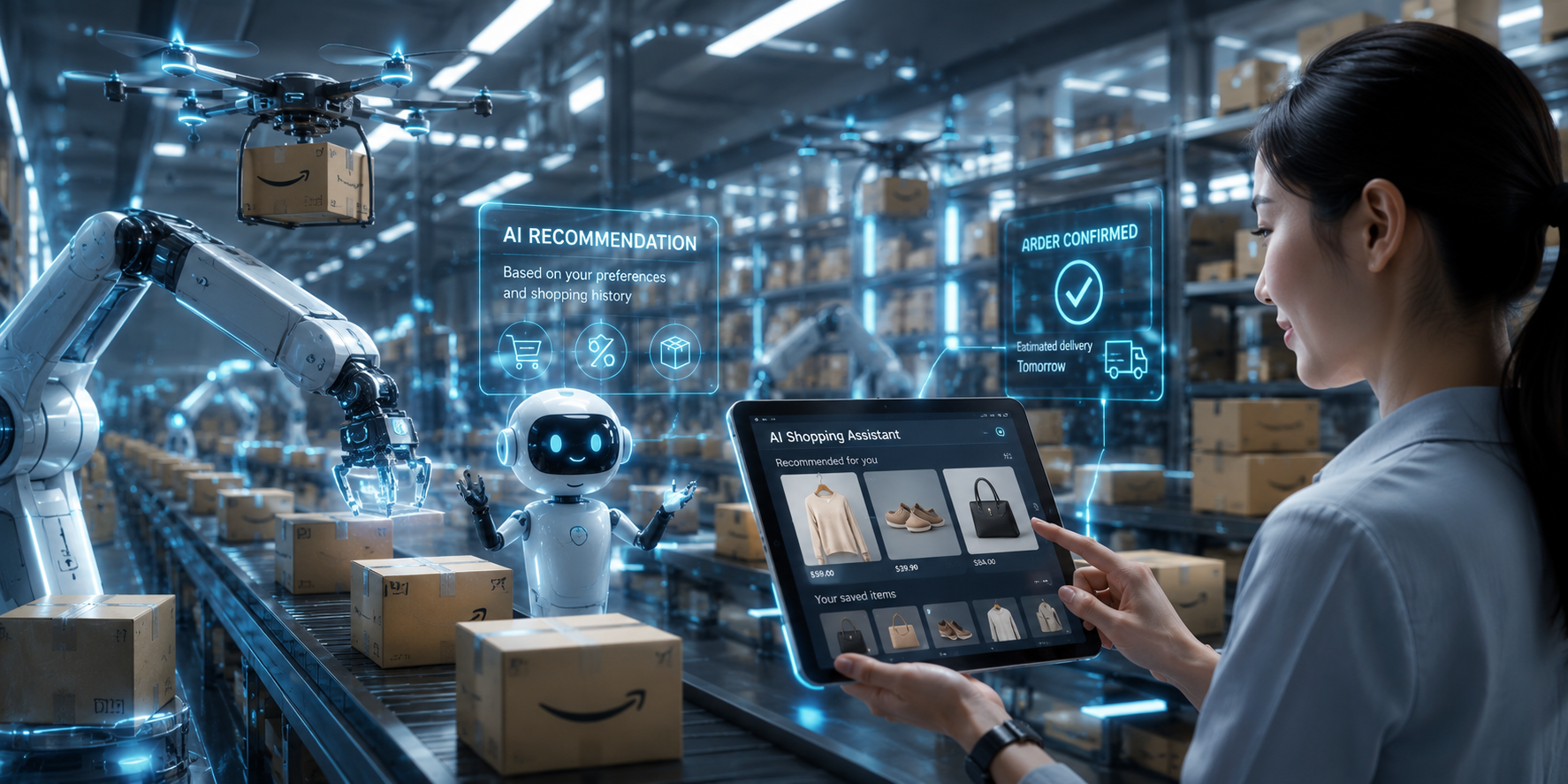
E-commerce continues to account for a growing share of global retail sales. According to Shopify, online sales represented 20.5% of total global retail revenue in 2025, and this figure is projected to reach 22.5% by 2028. As competition intensifies, AI has become a key competitive advantage for businesses seeking long-term growth.
Changing shopping behavior: Consumers are increasingly shopping through AI chatbots, voice search, and short-form videos, driving demand for highly personalized shopping experiences.
Increasing operational complexity: Managing products, inventory, orders, and customer data across multiple sales channels has become more challenging than ever. AI helps automate repetitive tasks, streamline workflows, and improve operational efficiency.
2. AI is driving e-commerce growth
From operations to marketing, AI is transforming nearly every aspect of e-commerce, enabling businesses to improve efficiency, enhance customer experiences, and strengthen their competitive position.
2.1 Optimizing product listings and improving product visibility
Product listings today require much more than keyword optimization. They must also align with how shoppers search using AI-powered assistants and natural language queries. This directly affects search visibility, click-through rates, and conversion performance.
Businesses are increasingly using AI to analyze market trends, research competitors, and optimize listing content based on real customer search behavior. These AI-driven insights help products rank higher in marketplace search results and generate more sales.
Recommended tool: Amazon Alexa for Shopping is Amazon's AI-powered shopping assistant that enables customers to search, compare, and discover products using natural language conversations.
2.2 Scaling digital content production with AI

Product images and videos significantly influence click-through rates and purchasing decisions. Instead of investing heavily in traditional photography and video production, businesses are increasingly using AI-powered image generation tools to create product visuals and promotional content quickly and cost-effectively.
As a result, businesses can accelerate product launches, reduce production costs, and improve operational efficiency.
Examples:
-
TikTok Shop: AI assists with script writing, transforms product images into short-form videos, and generates virtual hosts for livestream shopping.
-
Amazon and Walmart: AI image-generation tools create premium lifestyle images, A+ Content, and multiple creative variations for A/B testing to improve product visibility and conversion rates.
Recommended AI tools: Pebblely, Photoroom, Midjourney, CapCut, and HeyGen.
2.3 Optimizing pricing with AI in real time
AI continuously monitors competitor pricing, market demand, and consumer purchasing trends in real time, enabling businesses to implement dynamic pricing strategies.
This allows sellers to remain competitive while maximizing conversion rates, revenue, and profit margins.
2.4 Optimizing advertising costs
Advertising costs can quickly become difficult to control when bids and campaign settings are managed manually. Instead of monitoring hundreds of keywords and campaigns individually, AI analyzes advertising performance and automatically makes real-time optimizations.
AI can help businesses:
-
Allocate advertising budgets intelligently by prioritizing products, campaigns, and keywords with the highest conversion potential.
-
Identify high-performing keywords while eliminating search terms that generate clicks but fail to produce conversions.
-
Optimize bids automatically based on campaign performance, competitive conditions, and profitability objectives.
As a result, businesses can improve key performance indicators such as conversion rate, Advertising Cost of Sales (ACoS), and Return on Ad Spend (ROAS) without constant manual optimization.
Recommended tool: TikTok Shop Smart Performance Campaign (SPC) uses AI to automatically optimize bidding strategies, budget allocation, and ad delivery.
2.5 Forecasting demand and managing inventory across multiple channels

AI-powered demand forecasting solutions analyze sales velocity, replenishment lead times, and inventory carrying costs to predict future demand.
This enables businesses to maintain optimal inventory levels, minimize stockouts, avoid overstocking, reduce storage costs, and improve cash flow.
Recommended tools:
-
Prediko: Uses AI to forecast demand, optimize inventory, and recommend purchasing plans based on real-time sales data.
-
Inventory Planner: Helps businesses forecast demand, automate replenishment planning, and optimize inventory management across multiple sales channels.
2.6 Understanding customers through AI review analysis
Every customer review contains valuable insights into product performance and market expectations. AI enables businesses to analyze thousands of customer reviews to identify product issues, uncover unmet customer needs, and understand the features customers value most.
These insights help businesses improve products, enhance customer satisfaction, and make more informed business decisions.
Recommended AI tool: Thematic collects and analyzes customer reviews from platforms such as Amazon, Shopify, Google Reviews, and app stores, providing actionable insights into customer needs and product improvement opportunities.
3. The key benefits of localizing e-commerce operations with AI
Integrating AI into localization strategies has become a powerful driver of cross-border e-commerce growth. Businesses that leverage AI for localization can benefit in three key areas.
Breaking language and cultural barriers: AI adapts product content to local languages, search behavior, and consumer preferences, helping businesses build trust with customers in different markets.
Reducing operational workload: AI automates time-consuming tasks such as keyword research, translation, content creation, and image production, allowing teams to focus on strategic growth initiatives.
Increasing conversion rates and advertising performance: By continuously optimizing content, keywords, and advertising based on real-time performance data, AI helps businesses reach the right customers while maximizing marketing ROI.
4. The biggest challenge: "Garbage in, garbage out"
Although AI can dramatically improve operational efficiency, it does not automatically guarantee better business outcomes.
Overreliance on AI often results in highly standardized product content that lacks originality and weakens brand differentiation.
More importantly, AI is only as effective as the data it receives. Inaccurate, incomplete, or inconsistent product, inventory, and customer data will cause AI to amplify existing errors rather than solve them. Clean, accurate, and well-structured data remains the foundation of successful AI adoption.
5. A roadmap for optimizing e-commerce with AI
One of the most common implementation mistakes is attempting to deploy AI across every business function simultaneously. Instead, businesses should adopt AI gradually, prioritizing initiatives that deliver the highest return on investment (ROI).
Phase 1: Optimize product listings (Weeks 1–4)
High-quality product listings improve organic search rankings, advertising performance, and conversion rates without increasing marketing spend.
Businesses should use AI to audit their product catalog, identify underperforming listings, and discover high-converting keywords that improve marketplace visibility.
Phase 2: Automate PPC advertising (Weeks 5–8)
Once product listings have been optimized, paid advertising campaigns become significantly more effective.
Businesses can implement AI-powered PPC management solutions to automatically optimize bids, allocate budgets, and manage keywords based on real-time campaign performance. This stage focuses on improving advertising efficiency while generating additional profit for future growth.
Phase 3: Scale content production (Weeks 9–12)
After optimizing operations, businesses can leverage AI to generate product images, videos, and marketing content for multiple e-commerce platforms.
Automating content production accelerates campaign execution, strengthens brand consistency, and supports long-term revenue growth across sales channels.
Following this phased implementation roadmap enables businesses to optimize every stage of their e-commerce operations while building a scalable, AI-powered growth engine for sustainable success.
Partner with us to grow your Amazon business effectively.
Connect here to receive your free 1-on-1 consultation with AGlobal’s top experts.