Black Friday Amazon: 5 Mistakes Amazon Sellers Must Avoid
Black Friday on Amazon presents a major opportunity for businesses to boost sales, but it also comes with significant risks related to costs and profitability. Discover the 5 common mistakes businesses often make when running Black Friday campaigns on Amazon and how to optimize your strategy for better performance.
1. What Opportunities Does Black Friday on Amazon Offer Businesses?
 Black Friday has long evolved beyond being just a one-day discount event following Thanksgiving. It has become a major shopping season with a global impact. For Amazon sellers, this is an ideal time to maximize sales by tapping into massive shopper traffic. Taking full advantage of this opportunity can bring significant benefits to brands:
- Attract high volumes of traffic: Drive large numbers of shoppers to your Amazon Store or product listings.
- Boost sales: Increase conversion rates and revenue through promotional offers.
- Acquire new customers: Expand your customer base by reaching shoppers who have never purchased your products before.
- Increase brand awareness: Maximize visibility among millions of shoppers.
However, massive traffic also comes with intense competition. Driving traffic to your store is only the first step. Without optimizing listings, managing inventory, and calculating profit margins early, sellers can easily end up in a situation where “orders are pouring in, but the books are still in the red.”
Read more: Amazon Ads – Black Friday & Cyber Monday
2. Black Friday 2026 on Amazon: When Should Businesses Start Preparing?
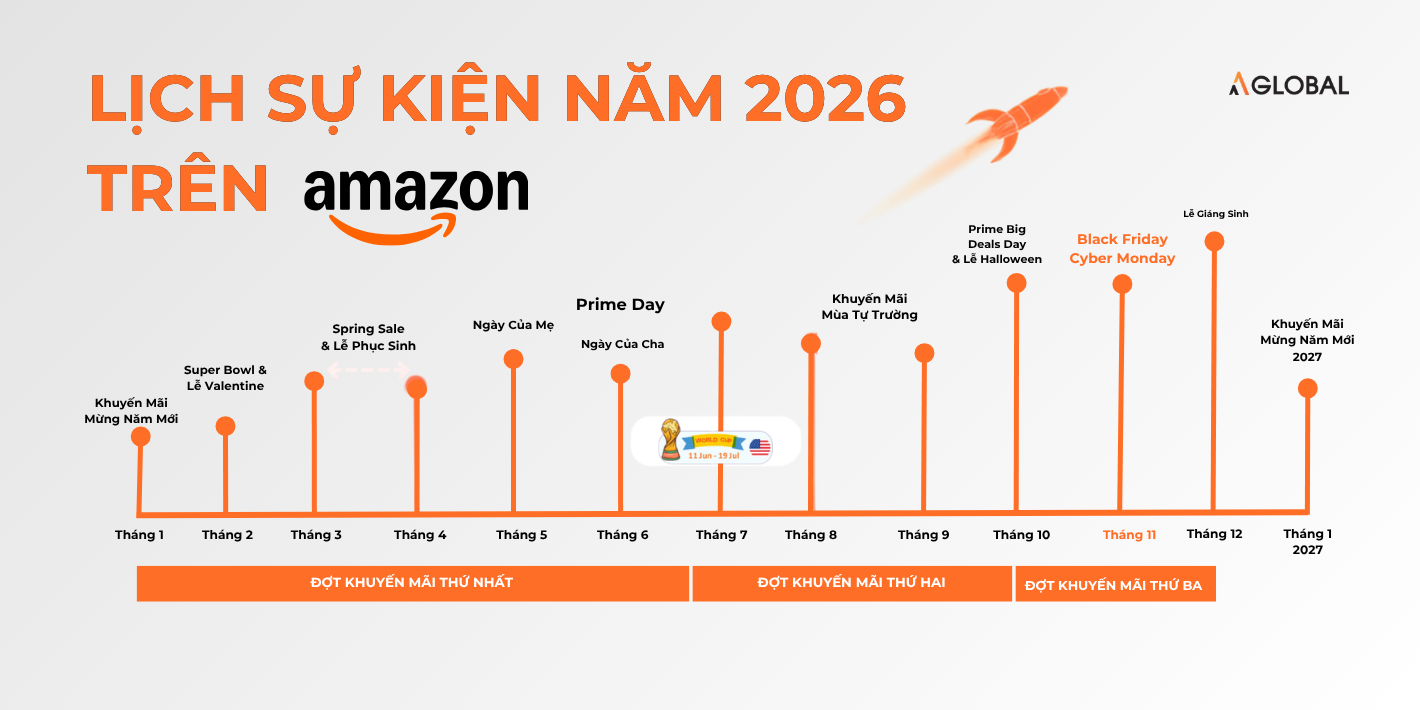 Black Friday 2026 is expected to take place on Friday, November 27, 2026, followed by Cyber Monday on November 30. However, Amazon typically extends its promotional activities across an entire shopping week. Businesses should therefore start planning for the peak season months in advance rather than waiting until the last minute to increase ad budgets or launch promotions.
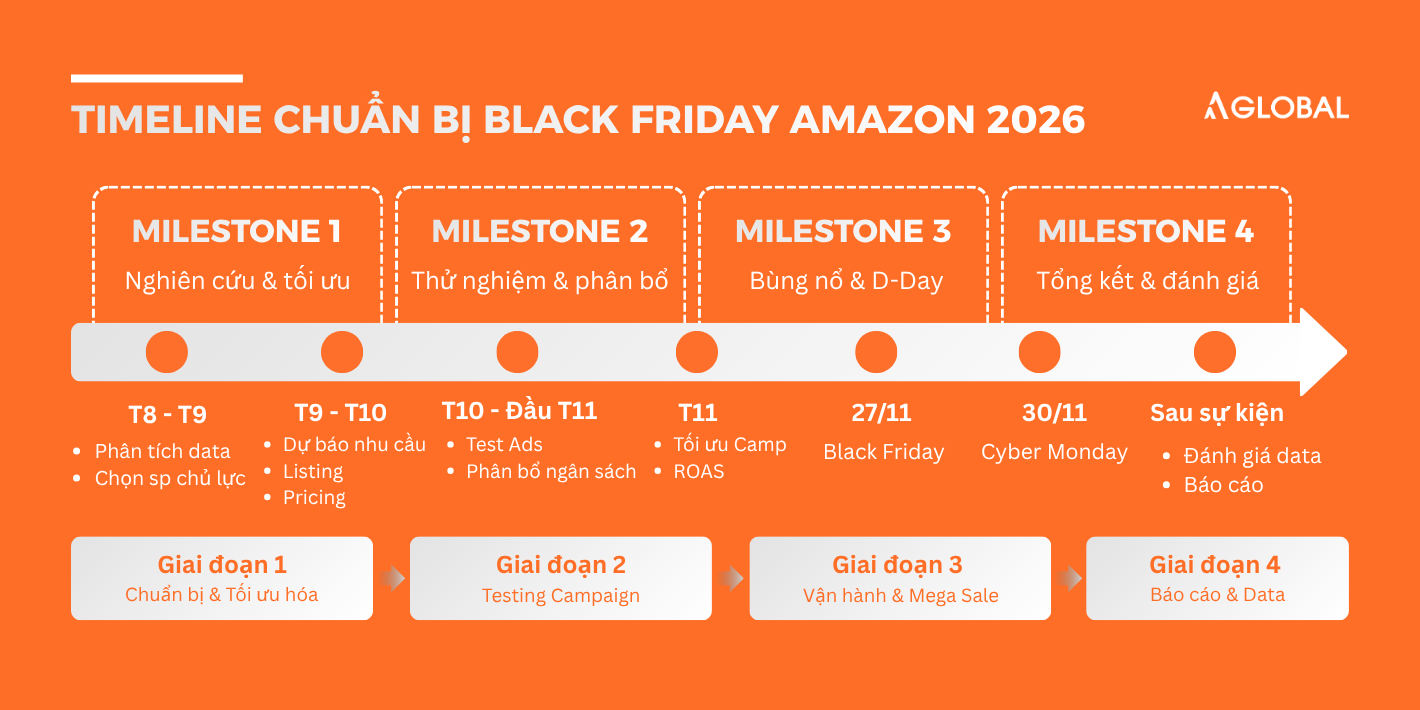
To make the most of the peak shopping season, businesses can divide their preparation into four stages:
- Stage 1 (Preparation & Optimization): Conduct research and optimization, including data analysis and selecting key products (August–September), followed by demand forecasting, listing optimization, and pricing strategies (September–October).
- Stage 2 (Campaign Testing): From October to early November, test advertising campaigns and allocate budgets based on performance.
- Stage 3 (Operations & Mega Sale): The peak sales period takes place throughout November, with a focus on campaign optimization and ROAS performance, reaching its highest point on Black Friday (November 27) and Cyber Monday (November 30).
- Stage 4 (Reporting & Data Analysis): Immediately after the event, starting from November 30 onward, businesses should evaluate campaign data and prepare performance reports.
3. 5 Common Mistakes Businesses Make When Running Black Friday Campaigns on Amazon
Before diving into complex budget optimization strategies, the first foundation businesses need to strengthen is product and inventory preparation.
3.1. Failing to Forecast Demand and Prepare Inventory Early
Running out of stock just as traffic surges not only means losing potential orders but also wasting the advertising budget already spent to drive that traffic.
However, inventory preparation does not mean “stocking up as much as possible.” Sellers need to determine the optimal inventory level based on three key factors:
- Actual data: Historical sales data and current sales velocity.
- Marketing campaigns: Promotional plans and expected advertising budgets.
- Supply chain: Production and shipping lead times, as well as FBA warehouse processing capacity.
Real-world example: After successfully addressing stockout risks following a Prime Day campaign, the Nissen brand recorded a 120% increase in advertising sales year over year during the following peak shopping season.
3.2. Offering Deep Discounts While Overlooking Profitability
Businesses can easily fall into the “revenue trap”: selling large volumes of products while ending up with zero or negative profit margins after all costs are deducted.
Before enrolling products in Black Friday promotions, brands should determine the maximum acceptable discount based on their total actual costs, including product costs, Amazon fees, advertising expenses, and logistics/FBA costs.
Real-world example: Haier Europe achieved a 213% increase in advertising sales and a 190% increase in ROAS. The key was not aggressive discounting, but flexible bid optimization and budget allocation based on the profit margins of each product line and market.
3.3. Spending Heavily on Ads While Your Listing Fails to Convert
The Amazon customer journey typically follows this sequence:
Amazon Ads → Traffic → Listing → Conversion → Sales
Advertising is responsible for bringing shoppers to your product, but the decision to purchase ultimately depends on the quality of your listing. This becomes particularly important during Black Friday, when shoppers are more likely to compare multiple products at the same time.
Before scaling your Ads budget, review your entire listing:
- Title & Main Image: Keep them clear, compelling, compliant, and optimized for relevant keywords.
- Product Images & A+ Content: Provide visual information and usage scenarios to help shoppers understand the product's value.
- Bullet Points: Highlight key benefits and unique selling points.
- Reviews/Rating: Monitor and manage customer reviews to strengthen credibility.
If your business wants to learn more about selling and building a business on Amazon, read: Amazon Agency – Comprehensive Solutions for Businesses Selling on Amazon
3.4. Failing to Adjust Amazon Ads Across Different Stages
Maintaining the same budget and bids throughout the entire sales season is a mistake that can limit a seller's growth potential. An effective advertising strategy should be divided into three stages:
- Before the sale (Launch): Focus on increasing Awareness, testing keyword sets, and collecting data to identify strategic products.
- During the sale (Acceleration): Allocate more budget to campaigns with strong Conversion Rates (CR) and ROAS, while closely monitoring inventory levels in real time.
- After the sale (Post-sale): Continue leveraging newly collected customer data to launch Remarketing and Cross-sell campaigns.
3.5. Focusing Only on Black Friday Sales and Overlooking Long-Term Value
The end of Black Friday does not mean the end of your campaign's value. If you only focus on the number of orders generated over a few days, you may miss out on a wealth of valuable data.
Instead of asking only, “How much did we sell on Black Friday?”, businesses should also evaluate:
- ROAS & Conversion Rate: Measure the actual effectiveness of advertising investment.
- New-to-Brand Customers: Assess the volume and quality of newly acquired customers.
- Top-performing Products & Keywords: Identify the most profitable products and keywords to inform future business strategies.
4. Conclusion
Black Friday on Amazon is not simply a race to offer the lowest price. It is a comprehensive strategic challenge that covers inventory management, visibility optimization, and budget allocation. Careful preparation and proactive cost management are key to turning every visit into tangible profit.
If you are looking for solutions to optimize your cross-border business on Amazon, AGlobal is ready to provide comprehensive services to help your store maximize sales during this peak shopping season.
Helping businesses sell more effectively on Amazon.
Connect with us here to receive a free 1-on-1 consultation from AGlobal's leading experts.