Amazon Prime Day: Why are sellers selling a lot but still losing money?
Prime Day: Why do sellers still lose money despite high sales? Sustainable profit optimization strategies to help Amazon sellers achieve real revenue growth.
1. Overview of Amazon Prime Day
Amazon Prime Day is Amazon’s largest annual shopping event, exclusively for Prime members worldwide. During the event, Amazon rolls out large-scale promotional campaigns across multiple categories, leading to a significant surge in traffic, competition, and advertising costs.
This year, the event is expected to take place in June 2026.
For sellers, Prime Day is not only an opportunity to boost sales but also a critical test of overall operational capability. Sales performance depends directly on pricing strategy, listing quality, advertising optimization, and inventory management—rather than relying solely on marketing budgets.
2. Why Amazon sellers still lose money during Prime Day
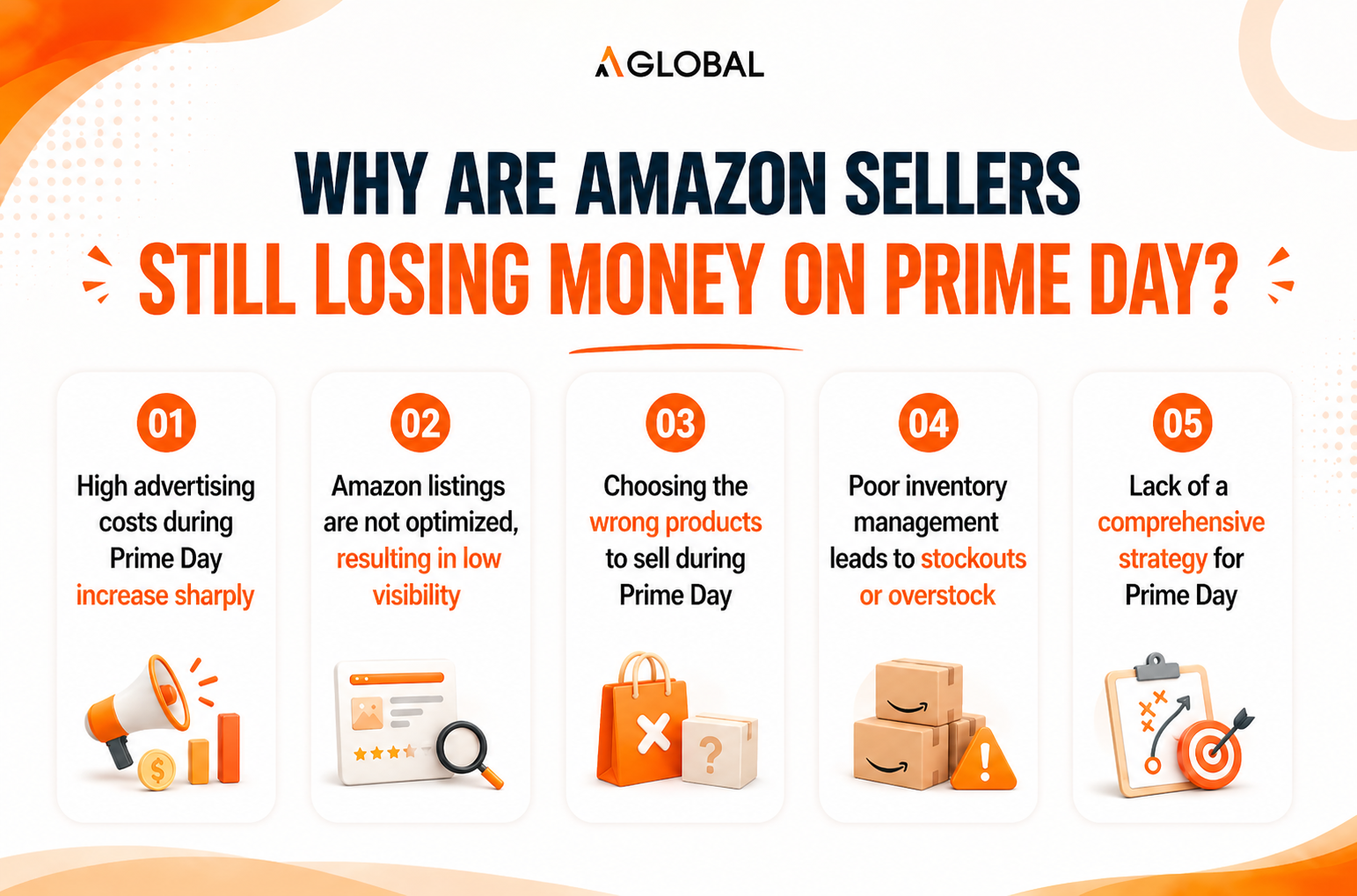
During Amazon Prime Day, revenue may increase significantly while profits decline if advertising costs and pricing are not properly controlled. Focusing on short-term sales while neglecting overall optimization often leads to the outcome of “high sales but low profitability.”
2.1. Rising advertising costs during Prime Day
Prime Day comes with intense cost pressure due to fierce competition. To maintain profitability, sellers need to understand:
-
Bidding competition: A sharp increase in traffic leads to aggressive bidding wars among millions of sellers, making costs highly volatile.
-
Margin risk: Without a clear bidding strategy, ad spend can easily exceed the break-even point, directly eroding net profit.
-
Shift in focus: Instead of “burning money” on ads, prioritize optimizing campaign structure and listing content to improve conversion rates.
-
Sustainable approach: Focus on protecting real profit margins rather than chasing superficial revenue growth.
2.2. Poorly optimized listings result in low traffic
Investing heavily in ads while having weak listings only leads to low conversion rates and skyrocketing cost per order. Don’t waste your budget on a “store” that isn’t ready for customers.
Common listing mistakes during Prime Day:
-
Titles lack primary keywords and essential details (size, color, material).
-
Low-quality product images, missing lifestyle visuals or infographics.
-
Lack of reviews and positive ratings reduces credibility.
-
Missing A+ Content limits competitive visibility.
2.3. Choosing the wrong products for Prime Day
Not all products are suitable for Prime Day promotion. Many sellers make decisions based on intuition or by copying competitors without proper analysis:
-
Low gross margins cannot absorb increased advertising costs.
-
Seasonal products may not align with Prime Day timing.
-
Bulky products incur high shipping fees.
-
Highly competitive categories drive costs up significantly.
2.4. Poor inventory management on Amazon
To maximize visibility and achieve sales targets, sellers must focus on the following inventory strategies:
Dual risk control:
-
Stockouts: Lead to lost revenue and ranking penalties from Amazon’s algorithm.
-
Overstocking: Ties up capital and increases storage fees, directly reducing real profit after the event.
2.5. Lack of an integrated Prime Day strategy
Prime Day is not just a discount event - it is a test of alignment between supply chain, operations, and marketing. Increasing ad budgets is ineffective without proper system-wide preparation:
-
No clear goals (revenue, profit, BSR ranking) before the event.
-
No budget allocation across pre–during–post Prime Day phases.
-
Failure to prepare deals (Lightning Deals or Prime Exclusive Discounts) in advance.
-
No contingency plan when advertising costs exceed expectations.
To achieve sustainable growth, sellers must build a comprehensive plan early.
3. A 4-Step Prime Day strategy to increase revenue and profit
The preparation phase plays a decisive role in overall performance. Sellers should implement the following:
3.1. Pre - Prime Day operational preparation
To ensure stable operations and optimize performance during Prime Day, sellers need to complete the following key task:
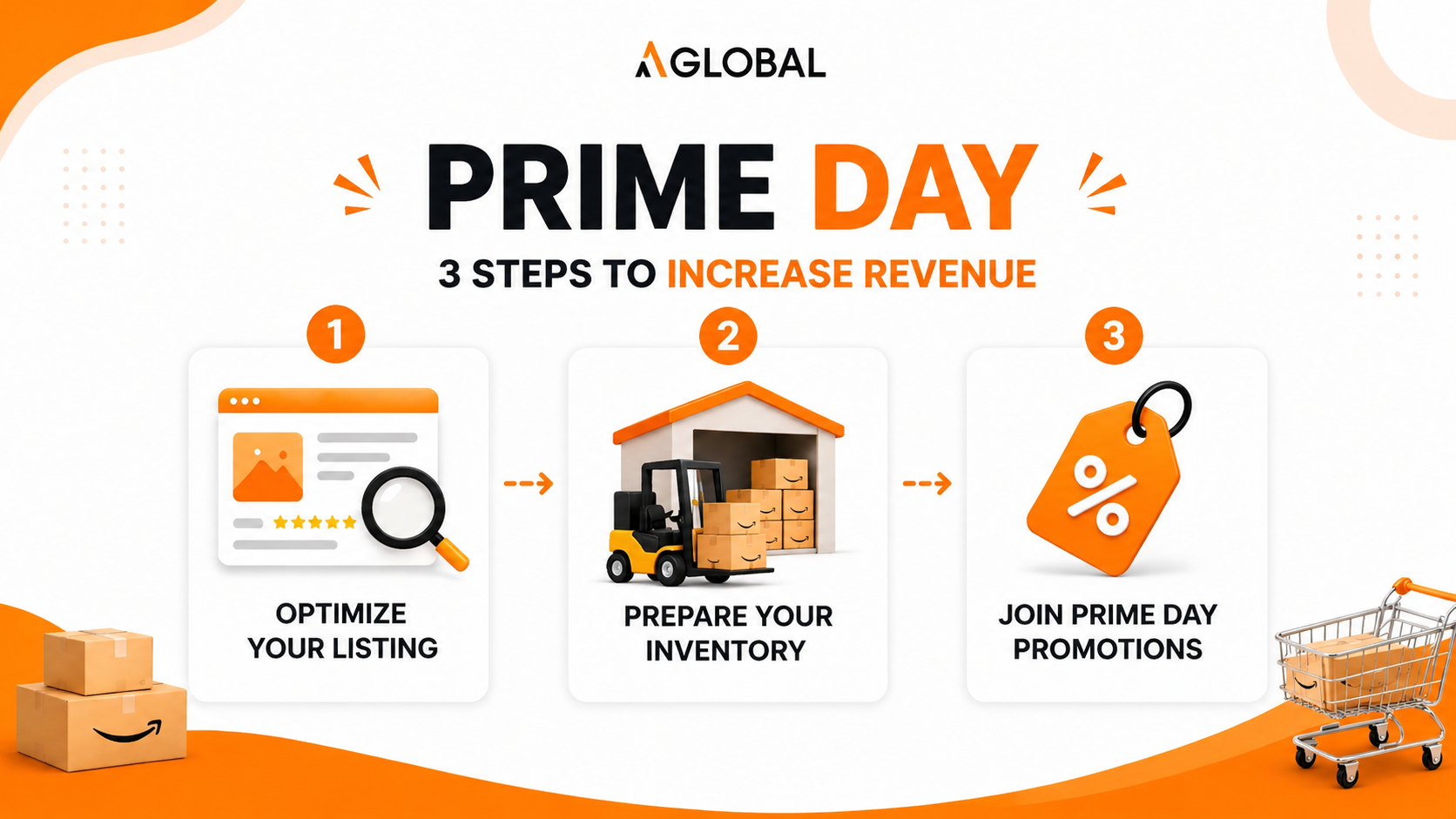
Optimize product listings
-
Audit titles, bullet points, and descriptions following Amazon SEO standards.
-
Upgrade to high-quality images and add videos where possible.
-
Implement A+ Content for brand-registered stores.
-
Increase product reviews using the “Request a Review” feature.
Prepare FBA inventory
-
Forecast demand based on sales data and Prime Day trends.
-
Send inventory to FBA warehouses 3–4 weeks in advance.
-
Maintain a healthy Inventory Performance Index (IPI).
Register promotions
-
Submit Lightning Deals or Prime Exclusive Discounts on time.
-
Set pricing strategically to balance competitiveness and profitability.
3.2. Building an optimal pricing strategy
A common mistake is getting trapped in price wars. Instead, apply a product-tiered strategy:
Core products:
Use Lightning Deals to boost ranking and visibility.
High-margin products:
Offer Prime-exclusive discounts to attract customers while maintaining listed prices and protecting brand value.
Golden rule:
Before launching promotions, calculate carefully: discounted price – platform fees – shipping – advertising costs.
If the result is negative, reconsider the strategy.
3.3. Advertising optimization
During Prime Day, advertising costs surge. Instead of spreading budgets thinly:
-
Control budgets based on performance metrics such as ACOS and conversion rate (CR).
-
Monitor performance by SKU.
-
Adjust budgets, bids, and keywords based on real-time data.
-
Analyze sales data and customer behavior continuously.
3.4. Post - Prime Day growth strategy
The post - event phase is a golden opportunity to maximize resources:
-
Performance analysis:
Evaluate actual profits after deducting operational costs, ads, and returns to identify core products. -
Customer journey optimization:
Leverage customer data to run follow-up campaigns and increase retention. -
Sustainable advertising strategy:
Transfer high-converting keywords from Prime Day into evergreen campaigns to maintain competitive positioning without relying on discounts.
4. Conclusion
Amazon Prime Day is a key revenue-driving opportunity of the year. With a well-structured strategy, it becomes a powerful lever to increase sales, improve rankings, and expand customer base.
Partner with us to grow your Amazon business effectively.
Connect here to receive your free 1-on-1 consultation with AGlobal’s top experts.